
31. July 2026
Author and picture credits: Alice Chabi Guiya, Abdias Bio Sika, Helvetas Benin
When the “Blue School” concept, one of the signature approaches of the Swiss Water and Sanitation Consortium, was presented to education stakeholders in the Alibori Department of Benin, an alignment exercise was undertaken. Teachers and supervisory staff came together in a workshop to identify which subject areas in the Beninese curriculum could accommodate Blue School themes (drinking water, sanitation, hygiene, gardening, reforestation, etc.). They successfully identified three main subject areas: French, Science and Technology Education, and Social Education. However, the theme of “growth and change” — which includes menstrual health and hygiene management (MHH) — is not aligned with the primary school curriculum. Given the importance of the topic as highlighted by school stakeholders, the supervisory team decided that menstrual hygiene would be addressed through community women. This marked the beginning of the project’s facilitation of educational discussion sessions on MHH.
Community Liaison Women (FRC from Femmes relais communautaires)[1] work on an almost voluntary basis to facilitate these sessions, supported by teachers and school principals who mobilise children on non-school days (Wednesdays and Saturdays). Having become role models for girls, the FRCs were trained to make reusable sanitary pads — a skill they subsequently passed on to the boys and girls participating in the educational sessions. Today, teachers and parents are pleased to see their children breaking taboos around menstruation; and it is with pride that girls own their menstrual cycles and are ready to share their knowledge with members of their community. One such girl is Oubéda, a pupil at the Ouagou public primary school in the commune of Banikoara.
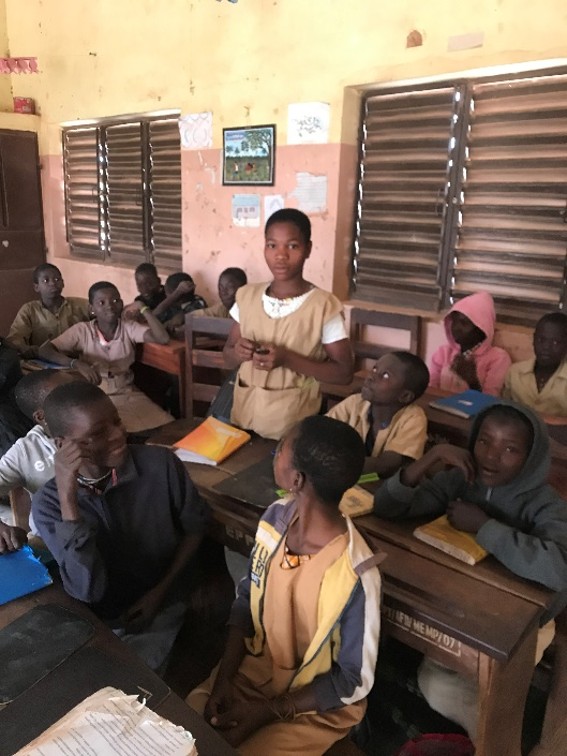
SABI GBESSA Oubéda participates in the discussion sessions and training facilitated by her village’s FRC on the proper management of menstrual hygiene in school settings. Curious, motivated and attentive, she quickly grasps the significance of what she is learning — not only for herself, but for all those around her. In Year 5 of primary school, Oubéda did far more than learn to make reusable sanitary pads; she became the first link in a chain of knowledge transmission at the heart of her own family.
From knowledge to action
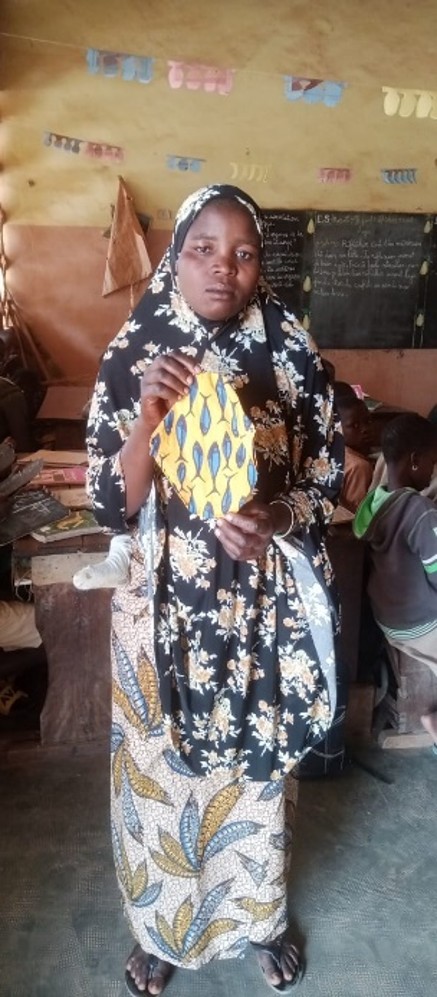
Back home, Oubéda becomes aware of a silent reality: her older sister, a trainee seamstress, faces real difficulties every month managing her periods, due to a lack of adequate information and accessible means. She decides to act. On her own initiative, she organises a full repeat performance of the training for her older sister, explaining step by step the principles of menstrual hygiene, the advantages of reusable protection, and the manufacturing techniques learned at school. Together, they make six sanitary pads from locally available materials (pieces of fabric, towels, thread and needles). Oubéda returns to school with one of the pads made with her sister and proudly holds it up to the FRC and the other schoolgirls. The FRC is equally proud to learn that her work has made a difference: “I was happy when she came back to show the pad; I understood that the training I gave had been mastered, because I was not at their home with Oubéda when she replicated the pad-making with her sister.”
An immediate and lasting impact
Thanks to this sisterly support, Oubéda’s older sister is now able to manage her periods with dignity and confidence, while reducing the costs associated with purchasing disposable protection.
Thanks to this training, I will now be able to manage my periods safely without anyone knowing. Not only will the costs of buying disposable pads be reduced, but that money will serve me for other useful purposes”,
shares Oubéda’s older sister, an indirect beneficiary of the training.
This experience is one of many in which pupils have replicated within their families what they have learned, creating a ripple effect in their communities. Similar replication has been observed for school gardens, handwashing stations (tippy-taps) and latrines — all of which have been built by households under the leadership of schoolchildren. This demonstrates that the Blue School approach is a channel through which children can truly become agents of behaviour change. Through Oubéda’s initiative, we see the full expression of systems strengthening — with the entire chain of actors functioning together and contributing durably to the health, dignity and empowerment of girls and women.
[1] Community Liaison Women (FRC) are an official mechanism of Benin’s Ministry of Health; they are formally identified and deployed in villages to carry out the Ministry’s routine activities (vaccination, malaria, polio, etc.)