
31. March 2026
In the past months, the Swiss Water and Sanitation Consortium (SWSC) further developed a costing toolkit for WASH services in healthcare facilities (HCF) and schools in collaboration with the Water institute of the University of North Carolina at Chapel Hill (UNC). SWSC first deployed the toolkit as part of a budgeting and advocacy project with eight healthcare facilities in Nepal in 2022. The learnings were published as a scientific study in Global Health: Science and Practice in June 2024.
The aim of the toolkit is to support school and HCF stakeholders to determine, in a straightforward way, the financial resources needed to achieve and sustain WASH services.
Determining costing data for WASH services in institutions can support advocacy efforts and policy implementation.
The costing toolkit consists of an Excel based worksheet and a user guide. It is available for HCFs and schools, in English and French and can be downloaded for free from the SWSC homepage. It considers costs across the entire lifespan of WASH services, including installation, operation and maintenance, trainings, decommissioning and disposal. The user guide explains each tab of the worksheet in detail and answers a few frequently asked questions at the end. When using the toolkit, please acknowledge UNC and SWSC as indicated on the last page of the guide and contact us in case of questions.
Several SWSC projects have applied the tool kit so far and are building up experience with it, also tracking concrete results obtained through implementation. Some reflections from the piloting:
Nepal: The project team conducted costing and advocacy activities in Thakurbaba municipality, with the aim of developing a budget and operations and maintenance policy for WASH in healthcare facilities in partnership with the municipal government. Cost findings were used to prepare annual budgets recommended to achieve and maintain basic access, which were presented to municipal government and incorporated into an operations and maintenance policy. To-date, the municipality has adopted the policy and established a revolving fund for repair and maintenance of infrastructures, and an additional budget per facility for discretionary WASH spending. Advocacy at the national level for WASH in HCF is currently being championed by the municipality. Findings from Thakurbaba are being used to inform development of a nationally costed plan for universal access.
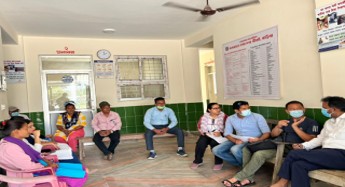
Bangladesh: The project team conducted costing for 17 HCF. It provided practical evidence on the actual financial requirements for implementing and sustaining quality WASH services. Key cost drivers were infrastructure upgrades, operation and maintenance (O&M), infection prevention and control (IPC) supplies, and staffing needs. The findings are a strong basis for improved planning, budgeting, and advocacy at facility and district levels. Up to now, the results have supported initial community-level resource mobilization, with locally collected funds being used for routine WASH maintenance, including minor repairs and essential IPC supplies. When local government institutions become fully operational after the local elections, the costing evidence will be used to advocate for the integration of WASH financing into routine health-sector budgeting.
Other SWSC projects are at various stage of implementing the costing tool with authorities aiming to finalise this year. In Mali, Burkina Faso and India, the tool for healthcare facilities has been applied and the tool for schools has been used in Nepal, Cambodia and Mozambique.